Roof Repairs
Repairs across Hornsby and the Upper North Shore, where gutters and valleys blocked under heavy canopy cause most water entry.
Learn more →Full roof replacement across Hornsby and the Upper North Shore in tile or Colorbond, specified for treed, bushfire-prone blocks. Free written quote.
Some roofs cannot be saved by another repair. Battens have gone soft, half the tiles are delaminating, the sarking was never there, and every heavy rain finds a new way in. At that point replacing the covering is the cheaper decision, not the extravagant one.
We quote full re-roofing across Hornsby and the Upper North Shore in both tile and Colorbond. The inspection and the written quote are free. Call (02) 9000 1127.
Replacement starts to make sense when several of these are true at once:
If only one or two apply, say so and we will quote a roof restoration instead. That is a genuinely cheaper path and on a sound 1970s concrete tile roof it is usually the right one.
Tile suits the streetscape through Beecroft, Cheltenham, Normanhurst and Wahroonga, where the housing stock runs from Federation and Arts and Crafts through inter-war and post-war, and where the roofline is part of what the street looks like. Modern concrete tiles lay fast and come with long product warranties. Terracotta costs more and lasts a very long time.
On a block with gums directly over the house, metal has a practical advantage: litter slides off a smooth profile instead of lodging in tile laps, and valleys stay clear longer. It is lighter, it suits low pitches, and it works well with the mid-century rooflines through Hornsby Heights and Berowra Heights. We cover this in detail on the metal and Colorbond roofing page.
Changing material is a structural decision as well as an aesthetic one. Framing built for tile can take metal easily; the reverse needs checking.
The Beecroft and Cheltenham Heritage Conservation Area is listed in the Hornsby Local Environmental Plan, with its character statement set out in Council's Development Control Plan. Houses inside it, and individually listed heritage items anywhere in the Shire, sit outside the usual exempt-development pathway when you change a roof's material, profile or colour.
That does not mean you cannot re-roof. It means the job starts with a conversation about what is appropriate and, where required, an application. We will tell you up front if your address is likely to be affected rather than discovering it halfway through.
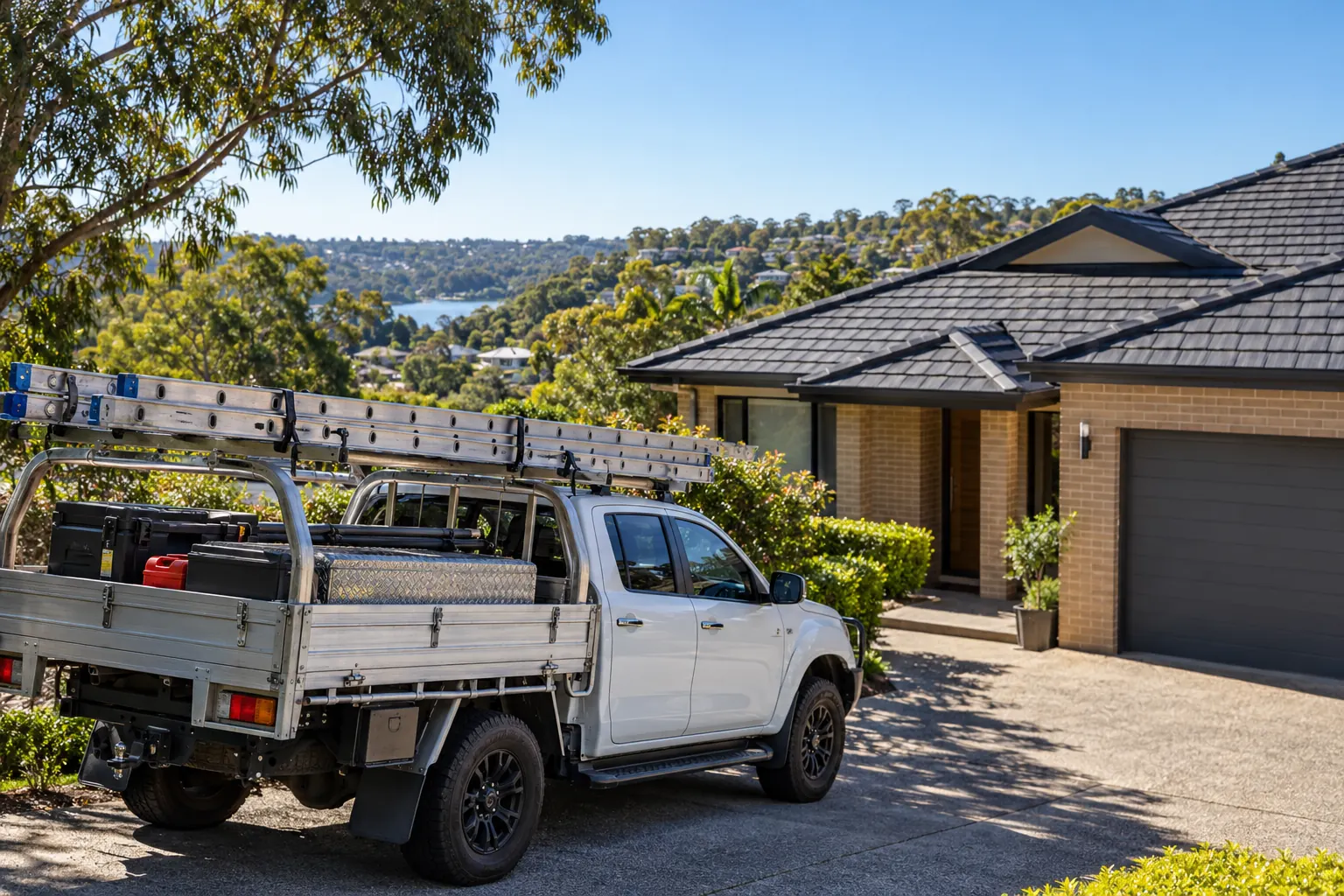
A large share of the Shire's residential land is mapped as bushfire prone on maps certified by the NSW Rural Fire Service, particularly around Berowra, Mount Kuring-gai, Cowan, Brooklyn, Westleigh, Hornsby Heights and the acreage country at Arcadia and Fiddletown.
Where that applies, new roof work is assessed against AS 3959 and the detailing changes: the roof is fully sarked, roof-to-wall junctions are sealed, any gutter or valley guard must be non-combustible rather than plastic, and openings get fine-aperture ember mesh. It is not a large part of the overall cost, but it has to be in the quote from the start.
Talk it through on (02) 9000 1127.
Roof size and pitch do most of the work in the number, then material, then access. A long steep run with a two-storey drop into a gully, a driveway too tight for a truck, or a canopy that has to be worked around all add time. Structural repairs found under the old covering are the usual variable, which is why we quote them as they arise rather than padding the original figure.
We will not give a dollar range over the phone for a roof we have not seen. We will give you an itemised written quote after the inspection, free, with no obligation to go ahead.
We quote replacements through Hornsby, Waitara, Normanhurst, Pennant Hills, Thornleigh, Mount Colah and Berowra, and out to the larger blocks at Arcadia. The full list is on the service areas page.
Call (02) 9000 1127 or request a free quote and we will come and measure it.
Repairs across Hornsby and the Upper North Shore, where gutters and valleys blocked under heavy canopy cause most water entry.
Learn more →Colorbond roofing across Hornsby, Berowra and the Upper North Shore, including non-combustible detailing near bushland.
Learn more →Restoration for Hornsby tile roofs carrying years of leaf debris, moss and perished pointing.
Learn more →Gutter replacement and ember-rated leaf guard across Hornsby, where leaf load and bushfire risk are the same job.
Learn more →Storm and fallen-limb response across Hornsby and the Upper North Shore, make-safe first.
Learn more →Roof inspections and written reports across Hornsby, including gutter and roof-line assessments at the bushland interface.
Learn more →It is a strong signal. Repeat repairs in one area usually mean the underlying structure or the detailing is wrong, not the tile. Once you add up three callouts, the ceiling repaint and the next one coming, replacement often works out cheaper over five years. We will show you the comparison honestly, including the case for restoring instead, rather than pushing the bigger job.
No. Re-roofing is done in sections so the house is never left open, and the old covering only comes off an area that can be dried in the same day. It is noisy and there is dust in the roof space, so people often move anything precious out of the ceiling cavity first. We also plan around forecast rain rather than stripping a roof with weather coming.
Usually yes, and on steep treed blocks it is a popular change because leaves slide off metal. Two things to check first: the roof framing was designed for a heavier covering, so battens and bracing may need adjusting, and if the house is a heritage item or sits inside a conservation area like Beecroft and Cheltenham, changing the roof material and profile can require consent from Council.
The old covering is removed from site and the roof space, gutters and valleys are cleared before handover. On blocks with a long driveway or a steep approach, where a skip cannot sit near the house, we work out the access plan at quoting stage and the cost of that is in the quote rather than appearing later.
For a standard single-storey house in reasonable weather, think several days rather than weeks. Steep pitches, two storeys, difficult access around established trees, structural repairs found once the covering is off, and bushfire-prone detailing all stretch it. The written quote gives you an expected duration and we tell you promptly if something found underneath changes it.
Tell us what you need and we'll get straight back to you. Prefer to talk? Call (02) 9000 1127 and speak to someone local.
Call (02) 9000 1127